OBJECTIVES: 1. General Characteristics of s - Block elements and Their compounds
2. Importance of s- Block elements and their compounds in daily life
INTRODUCTION : 1. The s block elements are the those who receives valence electron in s sub shell. In periodic table elements belonging to group no. 1 and 2 are considered as s block elements.
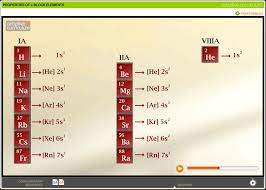
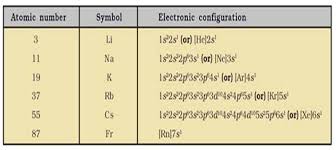
2. The general electronic configuration of s block elements is lNoble gas ] ns1 and [ Noble gas ] ns2.
3.Gr. no. 1 consists of Li, Na, K, Rb , Cs and Fr. Gr. no. 2 consists of Be, Mg, Ca , Sr , Ba and Ra. Fr and Ra is radio active elements.
4. Elements belonging to group no 1 are collectively known as ALKALI METALS as they react with water and form hydroxides are strongly alkaline in nature.
5. Elements belonging to gr.no. 2 are collectively known as alkaline earth metals because their hydroxides and oxides are alkaline in nature and their metal oxide are found in earth crust.
6. Li and Be are the first members of alkali metal and alkaline earth metal . Both exhibit similar properties which are different from other element of respective groups and the resemblance in their properties is also known as DIAGONAL RELATIONSHIP. It is due to similarity in ionic size or charge/radius ratio of elements.
7. All alkali metals having one valence electron . All are considered as most electropositive elements of periodic table. They easily loses one electron and form cation.
8. Alkali metal atoms having largest size in in particular period of the periodic table. The monovalent cation of alkali metals are smaller than parent alkali metal. Their size increases from Li to Cs in other words they follow the general trend of atomic and ionic radii.
9. The ionization enthalpy of alkali metals are very low and decreases from Li to Cs.
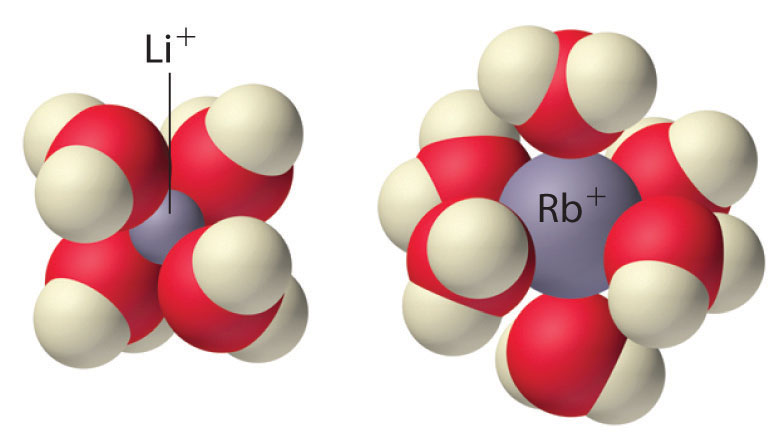
10. Hydration energy (also hydration enthalpy) is a term for energy released upon attachment of water molecules to ions. It is a special case of dissolution energy, with the solvent being water. For example, upon dissolving a salt in water, the outermost ions (those at the edge of the lattice) move away from the lattice and become covered with the neighboring water molecules. If the hydration energy is equal to or greater than the lattice energy, then the salt is water soluble. In salts for which the hydration energy is higher than the lattice energy, solvation occurs with a release of energy in the form of heat. For instance, CaCl2 (anhydrous calcium chloride) heats the water when dissolving. However, the hexahydrate, CaCl2·6H2O cools the water upon dissolution. The latter happens because the hydration energy does not completely cover the lattice energy, and the remainder has to be taken from the water in order to compensate the energy loss.
11.Facts about Lithium
The alkali metals are so reactive that they are never found in nature in elemental form. Although some of their ores are abundant, isolating them from their ores is somewhat difficult. For these reasons, the group 1 elements were unknown until the early 19th century, when Sir Humphry Davy first prepared sodium (Na) and potassium (K) by passing an electric current through molten alkalis. (The ashes produced by the combustion of wood are largely composed of potassium and sodium carbonate.) Lithium (Li) was discovered 10 years later when the Swedish chemist Johan Arfwedson was studying the composition of a new Brazilian mineral. Cesium (Cs) and rubidium (Rb) were not discovered until the 1860s, when Robert Bunsen conducted a systematic search for new elements. Known to chemistry students as the inventor of the Bunsen burner, Bunsen’s spectroscopic studies of ores showed sky blue and deep red emission lines that he attributed to two new elements, Cs and Rb, respectively. Francium (Fr) is found in only trace amounts in nature, so our knowledge of its chemistry is limited. All the isotopes of Fr have very short half-lives, in contrast to the other elements in group 1.
Physical properties of the alkali metals
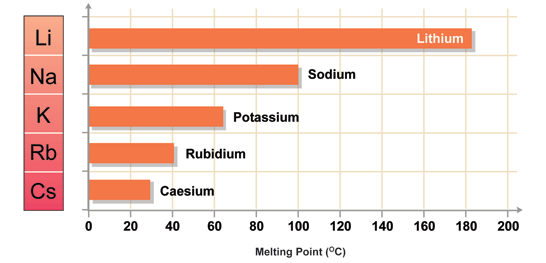
The alkali metals show trends in physical properties down the group.
Melting point
The alkali metals have low melting and boiling points compared to most other metals. Apart from the other alkali metals, only three metals (indium, gallium and mercury) have lower melting points than lithium. You can see from the graph that lithium, at the top of Group 1, has the highest melting point in the group. The melting points then decrease as you go down the group.
Boiling point
The boiling points of these alkali metals show a similar pattern to the melting points.
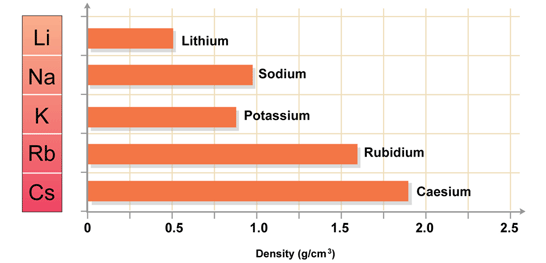
Density
The density of a substance is a measure of how much mass it has for its size. It is measured in grams/cubic centimetre. For example gold and lead are very dense metals - even a small lump of either of them can still feel heavy. The alkali metals have low densities compared to most other metals. (They feel lighter.) You can see from the graph that lithium, at the top of Group 1, has the lowest density in the group. The densities then generally increase as you go down the group.
Hardness
The alkali metals are very soft. Lithium is the hardest alkali metal and they become softer as you go down the group.
Reaction with cold water
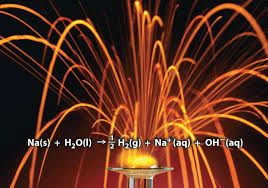
All the alkali metals react vigorously with cold water. In each reaction, hydrogen gasis given off and the metal hydroxide is produced. The speed and violence of the reaction increases as you go down the group. This shows that the reactivity of the alkali metals increases as you go down Group 1.
Lithium
When lithium is added to water, lithium floats. It fizzes steadily and becomes smaller, until it eventually disappears.
lithium + water → lithium hydroxide + hydrogen
2Li(s) + 2H2O(l) → 2LiOH(aq) + H2(g)
Sodium
When sodium is added to water, the sodium melts to form a ball that moves around on the surface. It fizzes rapidly, and the hydrogen produced may burn with an orange flame before the sodium disappears.
sodium + water → sodium hydroxide + hydrogen
2Na(s) + 2H2O(l) → 2NaOH(aq) + H2(g)
Potassium
When potassium is added to water, the metal melts and floats. It moves around very quickly on the surface of the water. The hydrogen ignites instantly. The metal is also set on fire, with sparks and a lilac flame. There is sometimes a small explosion at the end of the reaction.
potassium + water → potassium hydroxide + hydrogen
2K(s) + 2H2O(l) → 2KOH(aq) + H2(g)
Strong alkalis
The hydroxides formed in all of these reactions dissolve in water to form alkaline solutions. These solutions turn universal indicator purple, showing they are stronglyalkaline. Strong alkalis are corrosive, so care must be taken when they are used - for example, by using goggles and gloves.
Reaction with chlorine
All of the alkali metals react vigorously with chlorine gas. Each reaction produces a white crystalline salt. The reaction gets more violent as you move down Group 1, showing how reactivity increases down the group.
Lithium
If a piece of hot lithium is lowered into a jar of chlorine, white powder is produced and settles on the sides of the jar. This is the salt lithium chloride.
lithium + chlorine → lithium chloride
2Li(s) + Cl2(g) → 2LiCl(s)
Sodium
If a piece of hot sodium is lowered into a jar of chlorine, the sodium burns with a bright yellow flame. Clouds of white powder are produced and settle on the sides of the jar. This is the salt sodium chloride.
The reaction of sodium with chlorine is similar to the reaction with lithium, but more vigorous.
sodium + chlorine → sodium chloride
2Na(s) + Cl2(g) → 2NaCl(s)
Potassium
Potassium reacts more violently with chlorine than sodium does.
potassium + chlorine → potassium chloride
2K(s) + Cl2(g) → 2KCl(s)
The usual method for detecting compounds of the alkali metals is with a flame test. A platinum wire is dipped into a solution of the unknown compound and then placed into a hot flame. The color produced is characteristic of the alkali metal present. The lithium flame is bright red; sodium, yellow; potassium, violet; rubidium, dark red; and cesium, blue.
The compounds of lithium, sodium, and rubidium have a number of important practical applications, while the remaining alkali metals have only a limited number of uses.
Lithium
Lithium occurs in small amounts in Earth's surface, usually in association with compounds of aluminum. Most people know lithium best because of its use (in the form of lithium carbonate) as a way of controlling certain mental disorders. People who suffer from manic depression (a mental illness in which highly excited, agitated manic moods alternate with sad, depressed moods) can often benefit from regular treatments with lithium carbonate. Lithium is also used industrially in lubricants, batteries, glass, and alloys (mixtures of metals) with lead, aluminum, and magnesium.
Sodium
Sodium is the seventh most abundant element in Earth's surface. It occurs commonly in Earth's oceans in the form of sodium chloride and in crustal rocks as sodium chloride, sodium carbonate, sodium nitrate (saltpetre), sodium sulfate, and sodium borate (borax).
Compounds of sodium are among the most important in all of the chemical industry. Sodium chloride, as table salt, is one of the most widely used chemicals in the world. It also has many industrial uses, such as serving as a raw material in the production of other chemicals. Sodium nitrite is a principle ingredient in gunpowder. The pulp and paper industry uses large amounts of sodium hydroxide, sodium carbonate, and sodium sulfate; the latter is utilized in the production of cardboard and brown paper. Sodium carbonate is used by power companies to absorb sulfur dioxide, a serious pollutant, from smokestack gases. It is also important to the glass and detergent industries. Sodium hydroxide is one of the top ten industrially produced chemicals, heavily used in manufacturing. Sodium bicarbonate (baking soda) is produced for the food industry as well.
Sodium also plays some important roles in living organisms. It regulates nerve transmission, alters cell membrane permeability, and
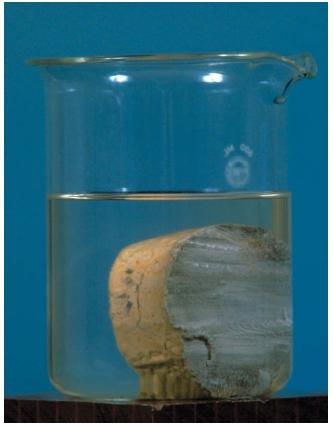
Sodium stored in oil to prevent its reaction with the surrounding air.
Alkali metals performs many other tasks necessary for maintaining life. On the other hand, excesses of sodium can aggravate high blood pressure.
Potassium
Like sodium, potassium occurs most commonly in the form of the chloride, potassium chloride. It is present both in sea water and as a mineral known as sylvite in Earth's crust. Almost all the potassium used industrially goes into fertilizer. Other important compounds of potassium include potassium hydroxide, used in the manufacture of detergents; potassium chlorate, used for the production of explosives; and potassium bromide, an essential chemical in photography. Like sodium, potassium is a vital nutrient for organisms in a variety of ways.
Rubidium, cesium, and francium
Rubidium and cesium are much less common than are sodium and potassium, ranking numbers 23 and number 45, respectively, in abundance. Both elements also have relatively few practical applications. Rubidium is employed primarily in various kinds of chemical research. One of its compounds has been used to treat patients with depression. In addition, some kinds of glass and radiation detection equipment are made with cesium compounds.
Francium is a radioactive element (one that spontaneously gives off energy in the form of particles or waves by disintegration of their atomic nuclei) and is one of the rarest elements in Earth's surface. It has no uses except for research.
The s-Block Elements in Biology
The s-block elements play important roles in biological systems. Covalent hydrides, for example, are the building blocks of organic compounds, and other compounds and ions containing s-block elements are found in tissues and cellular fluids.
Ion Transport
The Na+, K+, Mg2+, and Ca2+ ions are important components of intracellular and extracellular fluids. Both Na+ and Ca2+ are found primarily in extracellular fluids, such as blood plasma, whereas K+ and Mg2+ are found primarily in intracellular fluids. Substantial inputs of energy are required to establish and maintain these concentration gradients and prevent the system from reaching equilibrium. Thus energy is needed to transport each ion across the cell membrane toward the side with the higher concentration. The biological machines that are responsible for the selective transport of these metal ions are complex assemblies of proteins called ion pumps. Ion pumps recognize and discriminate between metal ions in the same way that crown ethers and cryptands do, with a high affinity for ions of a certain charge and radius.
Defects in the ion pumps or their control mechanisms can result in major health problems. For example, cystic fibrosis, the most common inherited disease in the United States, is caused by a defect in the transport system (in this case, chloride ions). Similarly, in many cases, hypertension, or high blood pressure, is thought to be due to defective Na+ uptake and/or excretion. If too much Na+ is absorbed from the diet (or if too little is excreted), water diffuses from tissues into the blood to dilute the solution, thereby decreasing the osmotic pressure in the circulatory system. The increased volume increases the blood pressure, and ruptured arteries called aneurysms can result, often in the brain. Because high blood pressure causes other medical problems as well, it is one of the most important biomedical disorders in modern society.
For patients who suffer from hypertension, low-sodium diets that use NaCl substitutes, such as KCl, are often prescribed. Although KCl and NaCl give similar flavors to foods, the K+ is not readily taken up by the highly specific Na+-uptake system. This approach to controlling hypertension is controversial, however, because direct correlations between dietary Na+ content and blood pressure are difficult to demonstrate in the general population. More important, recent observations indicate that high blood pressure may correlate more closely with inadequate intake of calcium in the diet than with excessive sodium levels. This finding is important because the typical “low-sodium” diet is also low in good sources of calcium, such as dairy products.
Some of the most important biological functions of the group 1 and group 2 metals are due to small changes in the cellular concentrations of the metal ion. The transmission of nerve impulses, for example, is accompanied by an increased flux of Na+ ions into a nerve cell. Similarly, the binding of various hormones to specific receptors on the surface of a cell leads to a rapid influx of Ca2+ ions; the resulting sudden rise in the intracellular Ca2+ concentration triggers other events, such as muscle contraction, the release of neurotransmitters, enzyme activation, or the secretion of other hormones.