
DISCOVERY OF ELECTRONS
In 1859 JULIUS PLUCKER performed an experiment with DISCHARGE TUBE . A discharge tube is a long glass tube fitted with metal electrodes . The tube is connected with vaccum pump . At very low pressure 10-4 atmosphere and a potential difference 10,000 volts, tube glows with faint greenish light which is due to bombardment of rays coming from cathode . These rays were called cathode rays since they are coming from cathode . These rays were found to cosists of negatively charged particles called electrons .
.
PROPERTIES OF CATHODE RAYS : The cathode rays possess following properties :
-
Cathode rays travel in straight line .
-
Cathode rays shows heating effect .
-
Cathode rays consists of material particle .
-
When electric field is applied to Cathode rays ,they get deflected towards positive plate .
-
Cathode rays are delflected by magnetic field in the direction expected for negative particles .
-
On striking against the wall of discharge tube cathode ray produces greenish faint glow .
-
cathode ray ionizes the gas through which they pass.
-
When cathode rays fall on the metal such as tungesten they produces X - rays.
-
They can penetrate through metal foil.
-
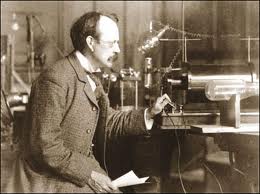
The charge to the mass ratio for the particles in the cathode is independent of the nature of the gas taken in the discharge tube or nature of the cathode. The above mentioned properties of cathode rays indicate that Cathode rays consists of fast moving stream of negatively chrged particles . . These particles were named ELECTRONS by J.J.Thomson.
DETERMINATION OF CHARGE BY MASS RATION OF AN ELECTRON
The e/m ratio for the particles in cathode rays were found to be same irrespective of the nature of cathode or the nature of gas taken in discharge tube . IT SHOWS THAT ELECTRON IS BASIC CONSTITUENT OF ALL ATOM .
R.A.MULLIKEN in 1909 determined the charge on the electron by OIL DROP experiment . It was found to be
1.6022 x 10⁻¹⁹ C .
MASS OF ELECTRON : On combining e/m ratio and charge of electron it was found that mass of electron = 9.1094 x 10⁻³¹ kg/electron . The mass of electron is approximately 1/1837 times the mass of Hydrogen atom .
ANODE RAYS OR CANAL RAYS : Goldstein in 1886 discovered the existence of new rays in the discharge tube . He used perforated cathode in discharge tube . On passing electric discharge at very low pressure he observed a new type of rays streaming behind the cathode . These rays were named anode rays or canal rays .
PROPERTIES OF ANODE RAYS : -
Anode rays travel in straight line .
-
Anode rays consists of material particle .
-
Anode rays are deflected towards negatively charged plates ,therefore, they are considered as positively charged .
-
Charge to mass ratio of anode rays depends on nature of gas taken in discharge tube .
DISCOVERY OF PROTON
It was observed that e/m ratio was maximum when hydrogen gas is taken in dischrge tube . It indicates that positive ion formed from hydrogen are lightest and they were named as PROTON .Charge to mass ratio for proton was found to be 9.58 x 10⁴ C/g and charge on electron is 1.6022 x 10⁻¹⁹ c positive charge . Therefore , Proton is a fundamental particle of atom .
RADIOACTIVITY : Discovery of electron and proton denied the concept of atomos which was further supported by the discovery of radioactivity phenomenon which was reported by BACQUEREL in 1896 .
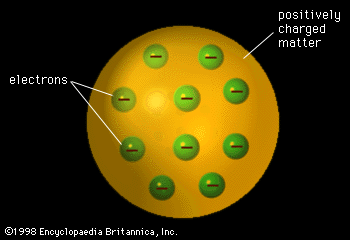
THOMSON'S ATOMIC MODEL : Thomson ( 1898 ) was first to propose the detailed model of atom . He proposed that atom consists of uniform sphere of positive charge in which electrons are distributed more or less uniformly . This model of atom is known as PLUM- PUDDING MODEL or RAISIN - PUDDING MODEL or WATERMELON model .
MERITS : Thomson's atomic model successfully explains electrical neutrality of atom
DEMERITS : This model was unable to explain obervations of Rutherford's scattering experiment.
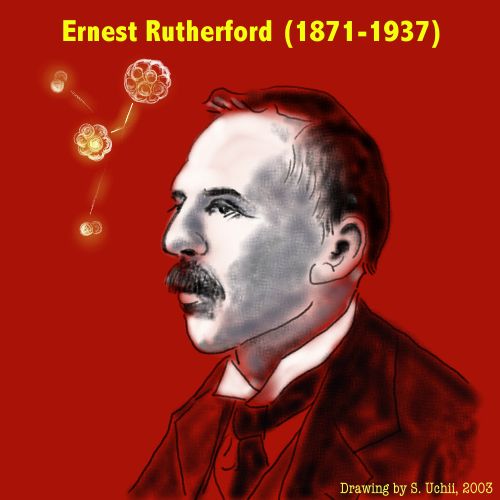
RUTHERFORD'S NUCLEAR MODEL OF ATOM : Rutherford in 1911 performed alpha particle scattering experiment . Thin sheet of gold ( thickness 100 nm ) was bombarded by alpha particles . Delection of particles were detected were a circular fluorescent sheet coated by ZnS which was placed around the gold foil .
OBSERVATIONS : Rutherford observed that :
1. Most of alpha particles ( 99 % ) passed through straight line and remains undeflected .
2. Some of the alpha particles deflected by small angle .
3. A very few of alpha particle ( 1 out of 20,000 ) were either deflected by large angle or or rebound back .
CONCLUSION : Rutherford concluded that :
1. Most of space in atom is empty because most of the alpha particles passed through the foil undeflected .
2. The small angle of deflection of alpha particles indicate the prescence of heavy positive centre in the atom which are reponsible for deflection of positively charged alpha particles.
Rutherford name the positive centre as ATOM .
3. As very few particles rebound back , the space ocuppied by heavy positvely charged centre is very small .
RUTHERFORD NUCLEAR MODEL OF ATOM
On the basis of scattering experiment Rutherford put forward his NUCLEAR MODEL of atom.
The main points of his model is
1. Most of the mass and all positive charge of atom is concentrated in a very small region of atom called NUCLEUS .
2. Size of nucleus is extremely small as compared with the size of atom . Just like a canvas ball in the centre of a circle of radius 5 km .
3. The positive charge on the nucleus is due to protons . The magnitude of the charge on the nucleus is different for different atoms of different element .
4. The nucleus is surrounded by fast moving electrons .
5. The electrostatic force of attraction on electrons are balanced by centrifugal force acting on revolving electrons .
6. Total negative charge on electron is equal to the total positive charge on the nucleus .
7 . Most of the space inside the atom is empty .
Due to similarity with solar system Rutherford's atomic model is also called PLANETARY MODEL OF ATOM .
FAILURE OF RUTHERFORD'S ATOMIC MODEL :
According to Maxwell a charged particles emits energy on acceleration in form of electromagnetic radiation .
According to Rutherford elctron are constantly moving around the nucleus . Since electron is charged particle it should continously emits energy in form of radiation . As a result of this the velocity of electron slow down with time and finally it moves closer and closer to the nucleus following the spiral path and ultimately electron fall on nucleus . Therefore, Rutherford's atomic model unable to explain the stability of atom .
Rutherford model of atom unable to explain the distribution of electron arund the nucleus .
Rutherford's model was unable to explain the existence of certain definite line in Hydrogen spectrum .
BOHR'S MODEL FOR HYDROGEN
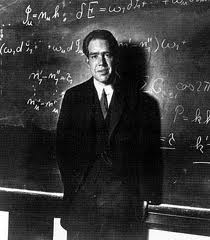
Neil's Bohr in 1913 proposed a new model of atom in order to overcome the shortcomings of Rutherford's atomic model .Main postulates of his model are
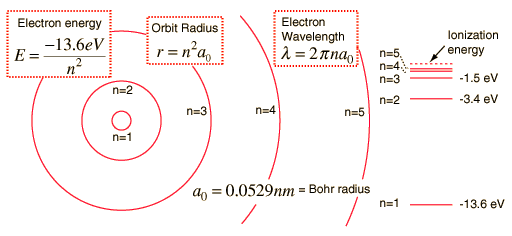
1. The electron in Hydrogen atom revolve around the nucleus only in certain allowed circular orbits . These orbits are associated with definite amount of energy content. These are called ENERGY LEVEL or ENERGY SHELL or STATIONARY SHELL. These are designated as K , L, M, N or 1, 2, 3, etc .
2. Only those orbits are permitted in which the angular momentum of the electron is whole number multiple of h/2 
mvr = nh/2 where n = 1, 2, 3, 4 .........
where m = mass of electron , v = velocity of electron , r = radius of radius of orbit . Therefore angular momentum of electron in atom is quantised .
3. When energy from outer sourse is given to electron , it may jump to higher energy level by absorbing definite amont of energy .This energy content is equal to the difference in energy of two energy level .
SUCCESS OF ENERGY OF BOHR'S MODEL
1. Bohr's model could explain the stabilty of an atom .
2. Energy of electron in particular orbit of hdrogen atom can be calculated with help of Bohr's Model .
3. Bohr's Model could explain the atomic spectrum of Hydrogen Successfully.
EXPLANATION OF HYDROGEN SPECTRUM BY HELP OF BOHR'S MODEL
According to Bohr's atomic model , electron in an atom can have only certain definite energy levels .Electon will jump from ground state to excited state when it absorbs certain amount of energy and by emitting such amount of energy it returns back to grond state.
Bohr model explain why there are certain discrete lines in the spectrum of Hdrogen atom .
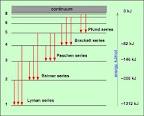
Hydrogen atom has only one electron . When energy is supplied to electron, it absorbs different amount of energies and and excited to different level . Now from excited state electron may return to grond state in one or more jump. Thses different downwards jumps are associated with different amount of energies hence result in the emmission of radiation of different wavelength which appears as different line in hydrogen spectrum.
Since different type of downward transition takes place simultaneously in a sample of hydrogen , therefore , large number of lines are obtained in emission spectrum of hydrogen . These lines are known as Lyman , Balmer , Paschen , Brackett and Pfund series representing the transtion of electron from higher level to first , second , third , fourth and fifth energy level .
Bohr's model was largely accepted at that time and he was awarded Nobel Prize for his work.
LIMITATIONS OF BOHR'S ATOMIC MODEL
Bohr's model suffer several limitation. Some of them are given below
1. Bohr's model unable to explain the spectra of multielectronic system .
2. Bohr's model unable to explain the splitting of spectal line in presence of Magnetic field ( Zeeman effect ).
3 . Bohr's model Unable to explain the splitting of spectral lines in presence of Electric field ( Stark's effect ) .
4. In 1923 de Broglie suggested that electron possess wave particle duality . Bohr treated electron as a particle and neglected its wave nature .
5. The orbiting of electron is against to the Heisenberg's Uncertainty Principle .In other words Bohr's model contradicts Heisenberg's uncertainty principle .
6. Bohr's model could not explain ability of atom to form molecule and geometry and shape of molecules .
CLASSICAL Vs QUANTUM CHEMISTRY
Bohr and other scientist upto 1923 applied classical mechanices on the motion of electron in other words they applied Newtonian's law of motion on the motion of subatomic particle . This was fundamental error which was removed by de broglie , Heisenberg and schrodinger.
The two new concepts laid to the development of Quantum mechanical model of an atom .
THE DUAL BEHAVIOUR OF MATTER
Einstein suggested in 1905 that light has wave as well as particle nature. In 1923 de Brodlie suggested that like light electron has also wave particle duality.
In order to overcome the limitations of the Bohr's model various attempts were made by scientists . The more general and suitable model of atom is based on two important concepts .
1. The dual nature of matter
2. Heisenberg's uncertainty principle .
Based on above two important principles Quantum mechanical model of atom was developed . This was start of new approach towards atomic structure.
THANKING YOU
